OWENSBORO LEAK REPAIR CO.
Call (270) 229-8689
OWENSBORO LEAK REPAIR CO.
Call (270) 229-8689
Most leaks announce themselves quietly, weeks before a stain appears. Here is what to catch early in an Owensboro house.
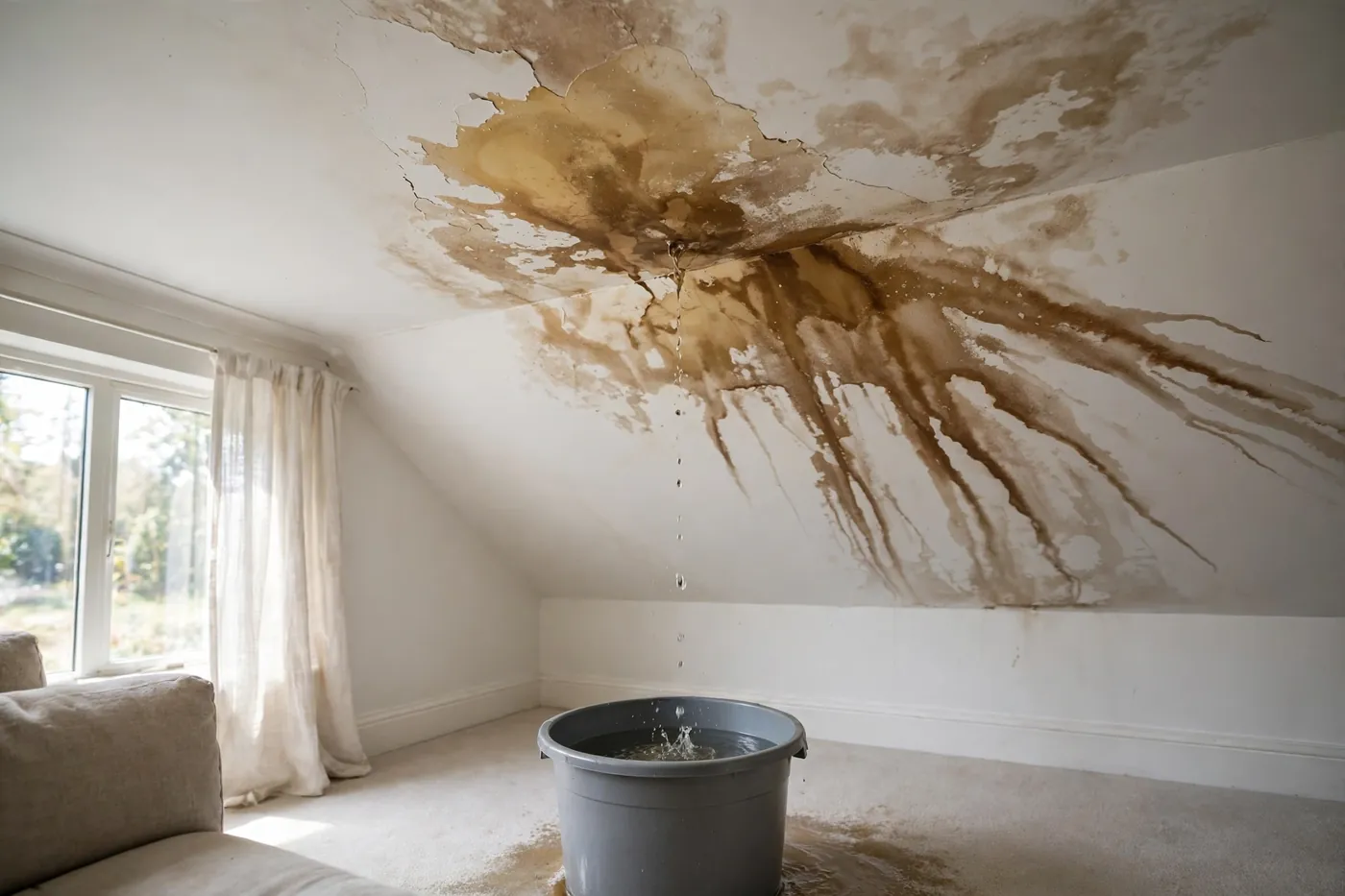
A ceiling stain is the last sign of a roof leak, not the first. By the time brown shows up on drywall, water has usually been getting in for a while — soaking insulation, running along decking, and finding its way through the path of least resistance. Owensboro houses make this worse in a quiet way: humidity off the Ohio River keeps a damp attic damp, so small leaks do not dry out between storms the way they might in a drier climate.
The good news is that a leak leaves earlier clues, if you know where to look. Some show up in the attic, some on the outside of the roof, and some in rooms that seem unrelated to the roof at all. This guide walks through seven of them, in the order you are most likely to notice them, and what each one usually points to.
A faint, musty smell in an upstairs bedroom or a closet under the roofline is easy to blame on humidity, and Owensboro has plenty of that. But a smell that stays in one spot, or comes back after a dry stretch, deserves a closer look. Damp insulation and damp decking smell different from general summer mugginess — heavier, more closed-in, and tied to one area of the house.
Check the attic above that room if you can do it safely. Look for insulation that feels damp or has clumped together, and for dark staining on the underside of the decking. Even a small damp patch matters. Water does not need a large opening to start soaking the layers under your shingles.
Go into the attic on a dry day with a flashlight and look up, not down. Stains on the underside of the roof decking — dark streaks, rings, or wood that looks grey instead of its natural colour — are a record of where water has traveled. A stain does not always mean water is active right now, but it does mean it got in at some point, and the entry point may still be open.
Follow the stain uphill if you can. Water runs downhill along rafters and decking, so the source is usually above and to one side of the mark you see inside. Note where the stain sits relative to chimneys, valleys, and vents, because those joints are where most Owensboro leaks start.
Shingles protect a roof by overlapping, so water runs off instead of sitting on seams. When shingles curl at the edges, crack, or go missing after wind, that overlap breaks. Wind in western Kentucky does not need to be extreme to lift an older shingle, and once one edge lifts, the next storm can drive rain underneath it.
You can spot a lot of this from the ground with binoculars. Look for shingles that look uneven, tabs that have folded back, and bare patches where the darker underlayer shows through. Granules in the gutter are a related clue: some loss is normal wear, but a sudden pile after a storm, or bare-looking shingles, suggests the surface is wearing thin and water has an easier path in.
Flashing is the thin metal that seals the joints where a roof meets something else — a chimney, a wall, a skylight, or a valley where two slopes meet. It is also where a large share of leaks begin. Sealant around flashing dries out in summer heat, then cracks when a cold snap hits, and the joint opens just enough for driving rain to push through.
Rust, gaps, or sealant that has pulled away from the edge are all worth noting. So is flashing that looks bent or lifted after a storm. Valleys deserve extra attention in Owensboro, because heavy rain concentrates there, and a valley that has lost its seal can let a surprising amount of water in during a single downpour.
A vent boot is the rubber or metal collar around a pipe that pokes through the roof — bathroom vents, kitchen vents, and plumbing stacks. The rubber ones crack with age and sun exposure, and the crack often starts on the side you cannot see from the ground. A cracked boot can leak for months while the roof around it looks fine.
From inside the attic, look for dampness or staining around the pipe where it passes through the decking. From outside, look for a boot that looks split, curled, or pulled away from the pipe. It is a small part, and a small failure, but it is one of the most common leak sources on houses of every age.
Paint that bubbles or peels on a wall near the ceiling, especially on an exterior wall or a wall under a valley, can be water working its way down inside the wall. So can wallpaper that loosens at the top edge, or trim that looks swollen. These signs show up when water has been running down a wall cavity rather than dripping straight through a ceiling.
It is easy to mistake this for a plumbing problem or a humidity problem, and sometimes it is. The difference is the pattern: paint trouble that follows a storm, or sits directly under a roof joint above, points to the roof first. If the same wall gets worse after rain and better during a dry spell, the roof deserves the inspection before the paint gets redone.
Water stains around a light fixture, a damp spot that appears only after wind-driven rain, or a ceiling that feels soft in one small area are all signs to act on quickly. A soft spot means the drywall has been wet enough to lose strength, and water near wiring should never be ignored — turn off the circuit for that fixture and keep the area dry until it has been checked.
These are also the signs where calling sooner is plainly better than waiting. A leak that has reached a fixture or softened drywall has already traveled through several layers of your house. An attic-first inspection can trace it back to the entry point, and photos of what is found will show whether the fix is a single joint or something wider.
Call now — emergency calls come first.
TAP TO CALL NOW